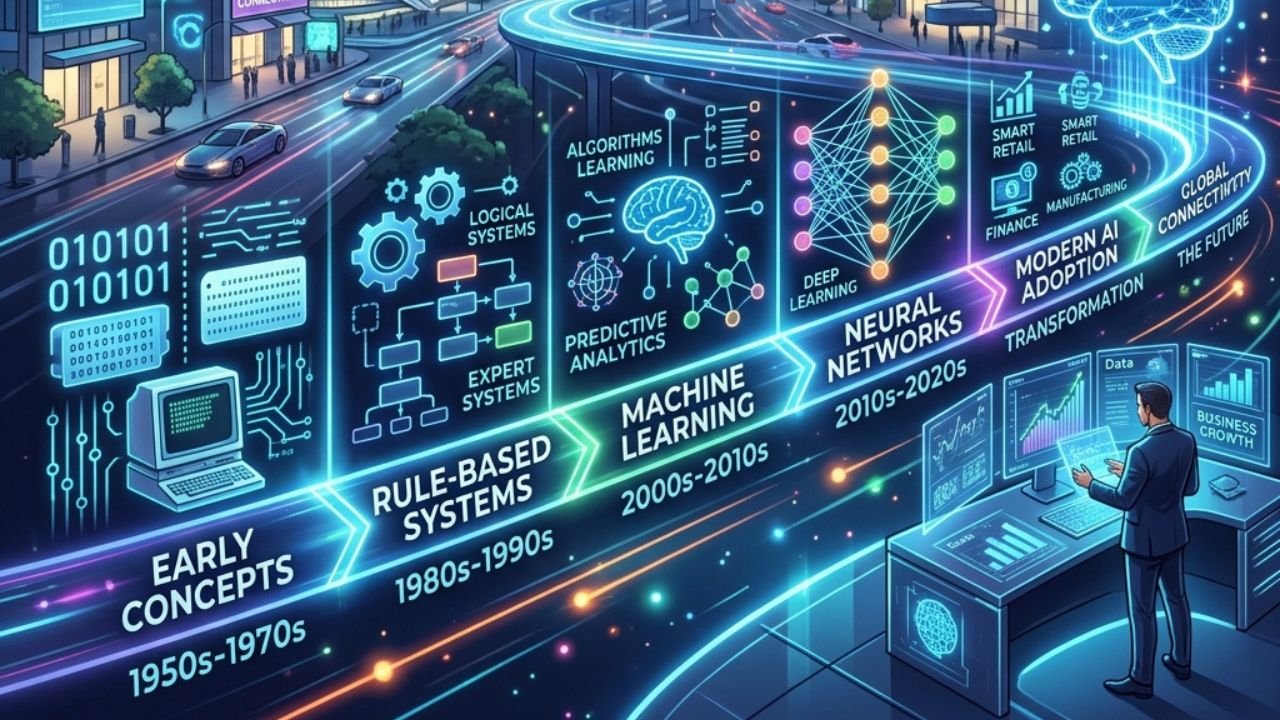
Artificial intelligence is reshaping how businesses operate—automating repetitive tasks, surfacing data-driven insights, and personalizing customer experiences at scale. From manufacturing to marketing, AI adoption is accelerating across every major industry, and organizations that integrate it strategically are gaining measurable competitive advantages.
Businesses that once relied entirely on human judgment to forecast demand, manage operations, or craft customer communications are now augmenting those processes with AI—and the results are hard to ignore. According to McKinsey’s Global AI Survey (2023), 55% of organizations report using AI in at least one business function, up from 50% the previous year. More tellingly, companies that have fully integrated AI into core operations report cost reductions of 20–30% in those functions.
This shift isn’t confined to Silicon Valley tech giants. Retailers, healthcare providers, logistics companies, and financial institutions are all finding practical, high-impact uses for AI. The technology has moved well past the experimental stage. For most industries, the question is no longer whether to adopt AI—it’s how quickly to do it well.
This post explores the history behind AI’s rise in business, the specific ways it’s changing key functions, and what organizations need to consider as they build their AI strategies for the years ahead.
The Evolution of AI in Business: From Theory to Everyday Tool
The concept of artificial intelligence dates back to the 1950s, when Alan Turing proposed his now-famous test for machine intelligence. Early AI research focused on rule-based systems—programs that followed explicit instructions to solve specific, well-defined problems. By the 1980s, “expert systems” were helping businesses in areas like medical diagnosis and financial planning, but these tools were rigid. They broke down quickly when faced with situations outside their narrow parameters.
The real turning point came in the early 2010s, when advances in computing power, cloud infrastructure, and the explosion of available data created the conditions for machine learning to flourish. Suddenly, AI systems could learn from experience rather than just follow programmed rules. Deep learning—a subset of machine learning—enabled breakthroughs in image recognition, natural language processing, and predictive analytics that made AI genuinely useful in commercial settings.
By 2017, AI had moved firmly into the mainstream. Google, Amazon, and Microsoft began offering AI-powered services through their cloud platforms, making enterprise-grade tools accessible to businesses of all sizes. Then came the large language model (LLM) revolution, most visibly represented by OpenAI’s GPT series starting in 2020, which democratized AI even further. Today, a small e-commerce startup can access the same underlying AI infrastructure as a Fortune 500 company.
How AI Is Changing Key Business Functions
How is AI improving customer service and support?
Customer service was one of the earliest business functions to benefit from AI—and it’s now one of the most transformed. AI-powered chatbots handle routine queries around the clock, reducing wait times and freeing human agents to focus on complex issues that require empathy and judgment.
But modern AI customer service tools go much further than basic chatbots. Platforms like Intercom and Zendesk use natural language understanding (NLU) to interpret nuanced customer requests, route tickets intelligently, and suggest responses to human agents in real time. Sentiment analysis tools scan customer communications to flag frustration early, allowing businesses to intervene before a problem escalates.
According to Salesforce’s State of Service Report (2023), 83% of service teams using AI reported time savings. For high-volume customer operations, those savings translate directly into cost reduction and higher customer satisfaction scores.
What role does AI play in data analysis and business decision-making?
Every modern business generates enormous amounts of data. The challenge has never been collecting it—it’s making sense of it fast enough to act on it. AI-powered analytics platforms address this directly.
Tools like Tableau (with its Einstein AI integration), Google’s Looker, and Microsoft Power BI use machine learning algorithms to identify patterns that human analysts would take days or weeks to find manually. Predictive analytics models can forecast customer churn, anticipate inventory shortages, or flag unusual financial activity before it becomes a significant problem.
The strategic implication is significant. Businesses that make decisions based on AI-generated insights rather than intuition alone are operating with a structural advantage. They course-correct faster, allocate resources more efficiently, and can model the likely outcomes of major strategic choices before committing to them.
How are marketing teams using AI to improve performance?
AI has fundamentally changed the economics of marketing. Personalization—once only achievable at scale by the largest platforms—is now accessible to businesses of every size.
Recommendation engines powered by AI analyze individual customer behavior to surface relevant products, content, and offers at the right moment. Email marketing platforms like Klaviyo use machine learning to optimize send times, subject lines, and audience segmentation automatically. On the paid media side, platforms like Google Ads and Meta Ads use AI to allocate budget in real time based on predicted conversion probability.
Content creation has also been transformed. AI writing platforms like Jasper enable marketing teams to produce high-quality copy, product descriptions, and campaign assets at a speed that wasn’t previously possible with small teams. This matters particularly for businesses that need to operate across multiple channels, languages, or markets simultaneously.
According to HubSpot’s State of Marketing Report (2024), 64% of marketers report using AI tools in their role, with content creation and data analysis being the two most common applications.
How is AI transforming supply chain and operations management?
Supply chain disruptions—highlighted acutely by the COVID-19 pandemic—exposed how vulnerable traditional operations management could be. AI-powered supply chain tools have since become a priority investment for manufacturers, retailers, and logistics companies.
Demand forecasting platforms like Blue Yonder and RELEX Solutions use machine learning to predict future inventory needs with far greater accuracy than traditional statistical models. These tools account for variables like weather patterns, local events, and macroeconomic signals that legacy forecasting methods can’t process effectively.
On the logistics side, AI route optimization software reduces delivery times and fuel costs simultaneously. Amazon’s use of AI to optimize warehouse operations—including its robotics systems—is one of the most cited examples of AI delivering measurable operational gains at scale.
What impact is AI having on human resources and talent management?
Hiring is time-consuming, expensive, and prone to human bias. AI-powered recruiting tools like Eightfold.ai and Pymetrics help companies sift through large applicant pools more efficiently, matching candidates to roles based on skills and potential rather than keyword matching alone.
Beyond recruiting, AI is being used for employee engagement analysis, onboarding personalization, and learning and development. Platforms like Humu analyze organizational data to recommend actions that improve team performance and reduce turnover. For HR leaders managing large, distributed workforces, these tools provide visibility that would otherwise be impossible to maintain manually.
What Are the Real Risks of Implementing AI in Business?
Honest conversations about AI transformation have to include the risks—and there are real ones worth taking seriously.
Algorithmic bias is a well-documented problem. AI systems trained on historical data can perpetuate and even amplify existing biases, particularly in hiring, lending, and healthcare. Regular auditing of AI outputs and diverse training datasets are essential safeguards, not optional extras.
Data privacy is another legitimate concern. AI systems require data to function—and the more sensitive that data, the higher the stakes for proper governance. Businesses operating in regulated industries (finance, healthcare, legal) need to ensure their AI tools comply with frameworks like GDPR, HIPAA, and emerging AI-specific regulations.
Job displacement is perhaps the most widely discussed risk. AI automates certain tasks effectively, and some roles will inevitably change or contract as a result. However, the more nuanced reality is that AI tends to change the composition of jobs rather than eliminate them entirely. Roles that combine human judgment with AI tools are becoming more valuable, not less.
Building an AI Strategy That Actually Works
Many organizations rush toward AI adoption without a clear framework—and end up with a collection of disconnected tools that don’t deliver meaningful results. A practical AI strategy starts with identifying high-value, high-friction business processes where automation or intelligence augmentation would create the greatest impact.
From there, successful AI integration typically follows three principles:
Start with existing data: AI systems perform better when trained on clean, well-organized data. Before investing in AI tools, audit your data infrastructure to ensure it’s up to the task.
Pilot before scaling: Run controlled experiments in one business function or team before rolling out AI organization-wide. Measure outcomes carefully, and use those learnings to refine your approach before expanding.
Invest in people, not just technology: AI tools don’t replace the need for skilled people—they change what those people spend their time on. Training employees to work alongside AI effectively is as important as selecting the right platform.
The Path Forward for AI-Enabled Businesses
AI is not a single technology with a single use case. It’s an infrastructure layer that’s becoming embedded in almost every part of how businesses operate—from the tools employees use daily to the models that inform the biggest strategic decisions.
Organizations that treat AI as a short-term efficiency play miss the larger opportunity. The businesses building durable competitive advantages right now are using AI to learn faster, serve customers better, and adapt to change more effectively than their peers.
The transition won’t be instant, and it won’t be frictionless. But the companies that invest in understanding where AI genuinely creates value—and build the internal capability to use it well—are positioning themselves for the decade ahead.
Frequently Asked Questions About AI in Business
What is artificial intelligence in a business context?
In a business context, artificial intelligence refers to software systems that perform tasks typically requiring human intelligence—such as analyzing data, generating content, recognizing patterns, or making predictions. Business AI tools range from chatbots and recommendation engines to predictive analytics platforms and automated workflows.
Which industries are being most transformed by AI?
AI is having the greatest near-term impact on industries with large data volumes and repetitive, high-frequency decisions. These include retail (personalization and inventory management), financial services (fraud detection and risk modeling), healthcare (diagnostics and patient management), logistics (route optimization and demand forecasting), and marketing (content creation and campaign automation).
How much does it cost to implement AI in a business?
Costs vary widely depending on the scope of implementation, the tools selected, and whether a business is building custom AI systems or adopting existing platforms. Off-the-shelf SaaS AI tools (like AI writing assistants or analytics platforms) can cost as little as a few hundred dollars per month. Custom enterprise AI implementations can run into the millions. For most small and mid-sized businesses, starting with purpose-built AI tools in one function is the most cost-effective entry point.
Is AI implementation risky for small businesses?
The risk profile for small businesses is different from that of large enterprises, but it’s manageable. The most common pitfalls are selecting tools that don’t integrate with existing systems, relying on AI outputs without human review, and underestimating the time needed to train staff. Starting with a well-defined use case and a reputable, established platform significantly reduces these risks.
How do I know if my business is ready for AI?
A useful indicator is whether your business has a clear process that generates consistent data and involves repetitive, rule-based decisions—or, conversely, a high-volume task where speed and personalization matter more than your current capacity allows. If you can answer yes to either, there’s likely an AI application worth exploring.